For my second Assignment I have to incorporate all that I have learnt so far within 'Elements of Design' into a set of photographs directed towards one subject.
We are given a list of subjects to choose from or we can provide our own. I have decided to base this assignment on my own choice of ANIMALS and INSECTS.
The following effects must be illustrated;
Single point dominating the composition
Two points
Several points in a deliberate shape
A combination of vertical and horizontal lines
Diagonals
Curves
Distinct, even if irregular shapes
Two kinds of implied triangle
Rhythm
Pattern
One of the main reasons behind my decision to improve my photography is my love for nature and wildlife, in all its forms. Animals aren't the easiest of subjects to work with and so far I have found that patience and planning is key, although on occasion the planning goes out the window and improvising pays off.
As I progress as a photographer, I'd like to be able to improve my understanding of the local wildlife in my area and in zoos, and to perhaps venture to Africa and India to capture these beautiful animals in their natural habitats.
Learning to understand their behavioural patterns will give me a better opportunity to use my photographic skill and capture them at their best.
Assignment 2 - Elements of Design
Single Point dominating the composition
 |
| f5.6-1/80-320-400mm |
The photo above was taken during a visit to Marwell Wildlife near Winchester in Hampshire. Marwell is a conservation wildlife park that not only allows people to see a vast range of animals, some of which are endangered, but it also helps at addressing the conservation problems in the UK and aboard.
I took this photo of a ‘Red Ruffed Lemur’ paying particular attention to focus in on the eye and frame the image in such a way that the lemurs black fur dominates the colour of the image; the orange ruffle around the side of its head and ears adds contrast and balance. However the eye, despite being composed in the centre of the image, is bright, alert and wide open, which strongly draws the viewer’s attention to it. I find myself wondering what the lemur is thinking as I gaze into his eye.
I’ve seen many fashion portraits in this style where focusing on the eye helps draw you into the image. I particularly like the work of Nick Knight and Jill Greenberg: their use of subject and colour mixed with varying expressions are inspirational. It is my aim to use this approach throughout this assignment.
On further reflection of the image, perhaps if I were to zoom closer in or crop the image slightly, the eye would appear more dominant, or possibly offsetting the eye more in line with ‘rules of thirds’ principal would result in a more appealing finish. However, the use of colours, composition and thought provoking subject I feel come together and demonstrate this element of design very well.
Two points
 |
| f2.8-1/1600-100-100mm |
Again whilst visiting Marwell Wildlife, one of the ostriches was parading very close to the viewing fence, so I decided to get up close and personal with it. Slightly hanging over the fence I was able to capture this shot of the ostrich walking towards me with the boy looking on in the background. I wanted to ensure I kept the ostrich as the main focus while blurring out the remanding surroundings. The boy in background acts as a second point of focus; the diagonal line (fence) draws the eyes attention towards him. This, combined with the shirt he is wearing, adds a slight contrast in colour which helps the overall composition of the photograph.
I’m fairly happy with the composition and use of lines and subjects within this photograph. If I could have changed the angle at which the shot was taken and perhaps aligned the ostrich off centre, while keeping the boy to the left of the image, this may have improved the composition. Shots such as these are and can be somewhat difficult to obtain due to health and safety reasons in a wildlife park!
In the animals’ natural environment, the scope of image increases but alongside this so does the risk, and the likelihood of getting such a shot are greatly decreased, making any wildlife shot challenging.
 |
| f2.8-1/640-100-100mm |
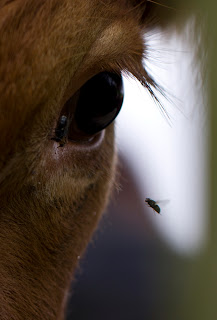
Whilst out walking along Odiham canal I came across a field with a herd of cows grazing. The nearby fence was partly broken and several cows started gathering nearby once I had been detected.
This shot was captured while I was shooting different angles and perspectives of the cows. When I looked closer I noticed I’d captured a fly, flying towards the cow’s eye. Whilst processing, I decided to crop the image so that the main focus was between the eye of the cow and the fly, and luckily enough the section of triangular light helps display this.
I sense some emotion within the photo, which to me appears sad, the eyebrow slightly drooped gives the appearance of the eye looking down which helps with this expression. When looking at the image I find myself constantly looking between the fly and the cow’s eye which I feel works very for this element of design. The depth of field could have been improved, perhaps from 2.8 to a smaller 5.6, making sure the background didn’t become too detailed so that the attention was taken away from the subjects. This would have helped more of the image come into focus.
Several points in a deliberate shape
 |
| f5.6-1/640-800-400mm |
The Amur Leopard is an endangered species due to the extensive habitat loss around the world, due to, deforestation, and mankind’s on-going search for natural resources regardless of what stands in our way. When you look at a leopard or ask the majority of people to describe one, the most popular answer will be ‘its spots’. The spots on a leopard are its natural form of camouflage which helps them blend into their surroundings, to avoid detection by its enemies or its prey.
This photo was taken at Marwell Wildlife and I have chosen this subject and photo to illustrate this element of design. The points represent the spots on the leopard and the shape is the distinguishing facial features of the leopard. Slightly hidden behind the wooden log and fast asleep, I had to be patient and wait for the opportune moment when it would life its head, reposition and open its eyes.
I like the arrangement and colour contrast in this image, with the leopards paw in the foreground being lighter than the rest. The green and browns that fill the remaining space help add balance.
The aperture is just about right to ensure the leopard stands out within the photograph and details of its hairs and whiskers draw the eye around the image.
Although perhaps not the easiest of elements to demonstrate and most likely open to peoples interpolation of several point in a defined shape, when applying these rules to wildlife I find I have to broaden my approach and look at different ways in how we see the world.
A combination of vertical and horizontal lines
 |
| f5.6-1/400-250-250mm |
On a visit to Longleat Safari Park this year I took this photo of a giraffe at the water hole while driving around the park on a visit to see Ann, the Indian elephant that was previously headline news due to the horrific treatment and beating she received whilst part of a circus.
The photograph here has captured the giraffe as it drinks, which demonstrates how a giraffe with its long neck is able to lower itself to the ground and drink without crouching down on its knees, and putting abnormal pressure through its limbs. The reflection in the water helps give the illusion of length and creates a single dominant vertical line. The use of the water holes edge supplies us with the horizontal element.
Vertical and horizontal line was a difficult element to express here. I could have settled for flocks of birds, and composed the image so that the horizontal lines were noticeable with the use of vertical line in some form of architecture. However patient I was, I never came across such an opportunity or location this time around. Given time would expand my search and look for such an opportunity.
Diagonals
 |
| f6.3-1/160-500-100 |
The photograph here was taken whilst out hiking one afternoon. The image is a close up shot of a crane fly, or commonly known as daddy long-legs, part of the Tipulidae insect family. I noticed it resting within the bush, and slowly and carefully managed to get close enough for this shot, using my 100mm macro lens.
I managed to take a few shots of this without disturbing the insect and finally decided to include this one because of the aperture setting and focal point. The image itself blends well in shape and symmetry so I have chosen to centre the subject post-capture, which I feel greatly enhances the diagonal features of the legs and wings. The colours are rich and subject fascinating - paying particular attention the crane-fly’s head gives us a real opportunity to see these almost ‘alien’ features which many miss.
The light on the twig towards the top of the frame is over exposed and perhaps on reflection I could have stopped down a little, or even tweaked the image further in Photoshop or used a HDR technique and stacked the image to compensate for this. While I was taking the shots I noticed how the crane fly did not move, meaning I could have tried to use a tripod to capture the images, and by manually adjusting the focal point I could have stacked and created a complete focused insect or at very least to include its wings, which I feel may have given a more integrated shot.
Curves
 |
| f5.6-1/800-400-135mm |
Here we have ‘Ann’ the Indian elephant abused within the Bobby Roberts Super Circus, recently brought to the public eye and thankfully re-homed at Longleat Safari Park. Following the news story and events, once I’d heard about Ann being moved to Longleat I knew I had to go and see her. Being the last circus elephant in the country to be removed from captivity, combined with her old age and rumored health problems, I was more determined that she was one magnificent animal I wanted to have the opportunity to see.
When I arrived the queue wasn’t long so I was able to spend some time patiently waiting and watching. It was very emotional watching her slowly plod around the yard, moving ever so carefully with each step. This photo captures Ann giving herself a sand bath. Using her trunk to suck up the sand, and in one swing blow it all over her, creating the perfect opportunity to demonstrate the element of curve in both her truck and the sand.
I would have liked to have had a wider aperture on this so that Ann stood out a little more from the background. However at the time I didn’t have a lens capable of this. Another way to achieve this would have been to zoom in further, compose the image so that I was still able to capture the movement enough while bring Ann more into focus.
Distinct, even if irregular shapes
 |
| f5.6-1/500-160-400mm |
Whilst out walking in Farlington marshes, adjacent to Portsea Island (Portsmouth) I noticed in the distance a flock of birds nesting on the local bushes and vegetation. While walking around, watching and photographing other local wildlife, the flock of birds became more active.
I decided to stop and watch, make note of their behavior and look for any patterns emerging. Once they had left the bush, they flew in a regimented style, not particularly following a pattern but closely synced to one another. They would leave the nesting area; fly in randomised route before settling again. It was not apparent if there was a leader for the group that the rest would follow.
The photograph I produced was cropped such that it focused in on a particular group that gives a great illustration of distinct shapes, through the use of their body, wings and tail. The direction and time of movement is not precise thus range of movement and shape within the image are distinct even is slightly irregular.
The image itself tends to be rather bland in colour, and although the dark colour and shape of the bird outline well against the soft cream of the field behind, perhaps by intruding a more prominent horizon would help at giving the photograph depth.
 |
| f2.8-1/125-160-100mm |
This photo was taken during a visit to Longleat Safari Park within the Lorikeet enclosure. Visitors are given the chance to walk through the enclosure and experience these magnificent birds up close. I took a number of photographs of these birds ensuring not to include any people within them, as I wanted to focus on the birds themselves.
I chose this photo to represent this element of design because of the detail within the feathers and beautiful contrasting colours. I decided to utilise a shallow depth of field to enhance the bokeh effect, to help the colours blend into each other and draw the eye towards the more detailed section of the Lorikeets feathers. The Lorikeet in the foreground is slightly distracting; however at the same time I feel it deflects the eye towards the main focal point.
On reflection I would have liked to increase the aperture to bring the feathers into focus more and perhaps have waited or looked for several Lorikeets perched on the branches to change the composition. However when I study this photo, I find myself drawn to the details of feathers, scanning the photos different aspects and it is generally pleasing to the eye.
Two kinds of implied triangle
 |
| f4.5-1/125-125-100mm |
Within Longleat Safari Park there’s a butterfly house which is home to many exotic species from all over the world. They display a vast range of colours and are a perfect example of delicate beauty. Sadly in our ever changing climate today you’ll notice a decline of butterflies within the UK, as we increase to populate more wooded areas and destroy hedges that once used to flourish with them.
The element of design shown here forms a perfect triangle converging in the center of the photograph. The composition and angle at which the photograph was taken enhances this effect by using the butterflies wing to form the implied triangle.
An aperture of f4.5 was used to bring enough of the butterfly in focus while still maintaining good depth of field behind the subject so that it would stand out from background. The pink flowers in the bottom left help add balance and interest to the photo.
 |
| f5.6-1/640-250-400mm |
This image was captured while out walking one evening as the sun was setting. A group of ducklings and their mother were spotted waddling along the mudflats until eventually coming to a break in the bank and entering the water.
I waited until all the ducks were in the water and swimming away, so that you could see the shape of the wake they left behind them. I composed the image so that a single duck was positioned at the top of the frame, the group of ducklings centered around the middle of the frame and a small section of the bank in the bottom of the photograph to add balance. Capturing this at sunset has given a warm orange glow to the water towards the top of the photograph and cast the subject mainly in shadow. The shape of the ducks wake clearly demonstrates the tip of an implied triangle. What I like about this photograph is number of implied triangles that can be seen and that the eye continuously scans the photo as each of these implied triangle has a duck/ducking at the head of it.
 |
| f2.8-1/500-100-100mm |
This photograph of a pig was taken while out at Longleat Safari Park within their encounter enclosure. I managed to get the pigs attention and decided to shoot from above the animal so that it would lift its head which has enabled me to get this portrait.
The implied triangle here can be seen between the pig’s ears, eyes and nose, so that it converges towards the bottom of the frame. The shape of the head, composition and angle all assist in illustrating this element of design.
On closure inspection of this photograph and as I learn more about portraits, whether animal or human, the photo here would have been better if the focal point were positioned on the pigs eyes. Perhaps an aperture of f5.6 or smaller would have given more detail in the image so that the eyes and nose were equally in focus.
What makes this photo work for me is the pig’s expression and sense of amusement. His nose covered in sand and wispy hair all adds emotion to the photograph. This together with the implied triangle help draws your attention to his sandy nose.
Rhythm
 |
| f2.8-1/400-100-100mm |
During a visit to Marwell Wildlife the Nyala (animals shown here) had their attention caught by something happening in the distance. I felt this made quite an amusing photograph as the position of their bodies face one direction yet every single Nyalas’ head faced another.
I decided to crop this photo so that the wires at the front of the enclosure were not noticeable. I wanted to draw the attention towards the Nyalas and remove anything distracting. Each Nyala standing in a different position and being staggered within the group formation makes the viewers eyes pan across the photograph, looking through each animal. The end result is a good illustration of this design element – Rhythm.
It would have been better if the fence in the background could have been removed or blurred out, although this element was out of my control. Photographing these animals in their natural habitat would be produce a far more appealing image, however the design principals and elements that I learn through this process will prove invaluable given the situation where I can put these into practice on the plains of Africa.
Pattern
 |
| f2.8-1/250-100-140mm |
This photograph of a zebra was captured at Marwell Wildlife. Some of the zebras were grazing close by, which enabled me to get this close up of the zebra’s mane.
I decided when composing the image to keep the aperture wide open so that only a small section of the image was in focus. I waited for a second zebra to pass in the back ground so that the photo would have more depth. Once the image was processed from its RAW file I converted it to black to white to add a more powerful and dramatic effect to the image.
The patterns of the stripes on the zebra are what are striking within this photograph. The depth of field and level of greys also help this photograph stand out. Further analysis of this photograph could be seen as misleading, as the shape of the zebra’s neck and back, together with the composition of the photograph, one could argue that this element of design is more rhythm than pattern. However the photograph can still remains static if the viewer wishes.
Perhaps this images best demonstrate BOTH ‘Rhythm’ and Pattern’ at the same time!
Resources and inspiration used for this assignment have been gained from fashion photographers, Nick Knight and Jill Greenberg and Wildlife photographers Geoff Simpson, Andy Rouse, George McCarthy and Chris Gomersall all of whom are exceptional photographers in their field and excel in capturing evocative images of wildlife.